FROM KYOTO TO YOUR WORKSHOP
Japanese woodworking is more than technique.
TRADITIONAL JAPANESE WOODWORKING — Mastering the Timeless Art of Joinery
An English-language book by Japanese carpenter Takami Kawai.

The book introduces Japanese woodworking through tools, chisels, kanna planes, sharpening, reading wood, material selection, and traditional joinery, with detailed photographs throughout.
But this book is not only about how to make.
Why is a particular piece of wood used in a particular orientation?
Why are tools sharpened and adjusted with such care?
Why does the direction of the grain matter?
Why is preparation and observation sometimes more important than working quickly?
Behind every technique lies another question:
Why do we do it this way?
That question is at the heart of this book.
⸻
HOW TO MAKE.
HOW TO SEE.
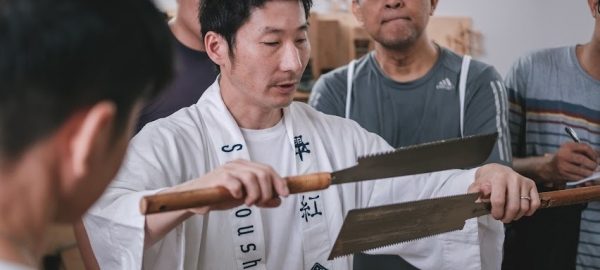
We do not believe that all woodworking skill can be acquired simply by reading books or watching videos.
You have to touch the wood.
Hold the tool.
Plane it.
Cut it.
Make mistakes.
Recognize those mistakes, think about them, and correct them.
Skill develops little by little through the accumulation of those experiences.
That is why we created Suikoushya, a small woodworking school in Kyoto.
Our classes are intentionally small.
The teacher watches each student’s hands, the angle of the tool, the sound of the blade, and the surface left on the wood.
There are things in woodworking that cannot be fully communicated through words, photographs, or film.
That belief has not changed.
But at the same time,
there are things that a book can communicate precisely because it is a book.
What does a carpenter look for in a piece of wood?
How does he think when a problem appears?
Why does he choose one tool over another?
Why does he use a particular piece of wood in a particular place?
Why does he make a joint in a particular way?
A book can carry not only technique, but also the judgment and thinking behind that technique, far beyond the workshop.
⸻
ABOUT TAKAMI KAWAI
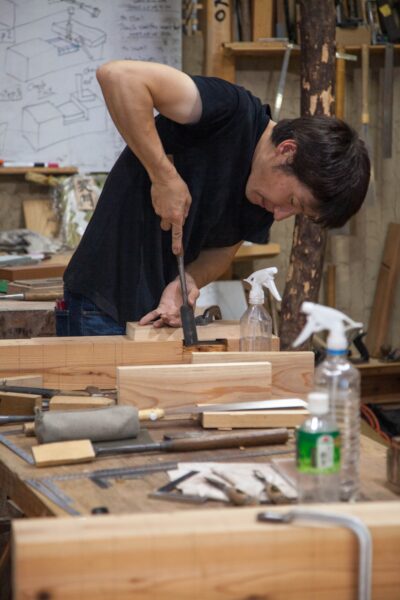
Takami Kawai is a Japanese carpenter based in Kyoto.
After studying architecture at university, he trained as a carpenter in Miyama, Kyoto.
He later spent approximately four years working on the 62nd Shikinen Sengu of Ise Jingu.
Today, he runs Suikoushya in Kyoto, where students from around the world come to study Japanese woodworking.
Our in-person classes are currently almost fully booked through the end of 2027.
But that does not mean we want to replace the school with online learning.
Quite the opposite.
The school remains small because there are things that can only be communicated through direct, face-to-face teaching.
At the same time, we began to ask:
What can we share with people we may never be able to meet in person?
Books and films have a different role.
⸻
THE BOOK
The book explores:
Japanese woodworking tools.
Chisels.
Kanna planes.
Tool setup.
Sharpening.
Wood species and grain.
How to read wood.
Making a kanna dai and toolbox.
And a wide range of traditional Japanese joints.
These practical techniques are explained through detailed photographs and commentary.
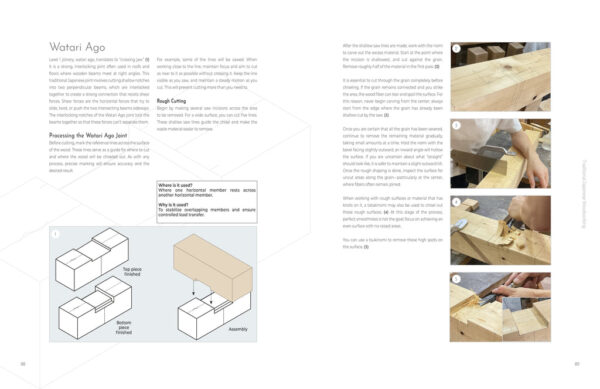
But this is not a book about shortcuts.
For example, even something as specific as the bevel angle of a kanna blade cannot simply be reduced to:
“38 degrees is correct.”
The appropriate angle changes depending on the hardness and character of the wood.
Even wood from the same species may behave differently depending on where and how the tree grew.
So instead of looking only at the number:
Look at the wood.
That way of thinking appears throughout the book.
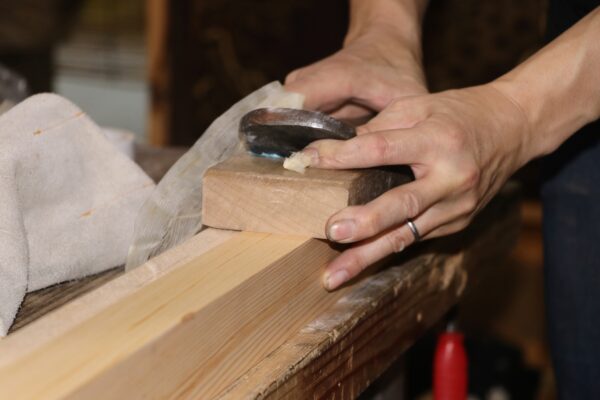
Knowing about woodworking and actually being able to do it are not the same thing.
But a book can help you understand what to look for.
It can help you understand why a tool matters before you have spent years using it.
It can introduce you to a different way of thinking about making.
That is the role of this book.
⸻
THE WORKSHOP FILMS
There are things that photographs cannot easily communicate.
The movement of a kanna across wood.
The sound of a properly sharpened blade.
The position of the body.
The pressure in the hands.
The rhythm of sharpening.
The moment when a carpenter stops, looks at the wood again, and changes a decision.
Suikoushya also offers films and Video Lessons recorded inside the workshop.
They are not a replacement for face-to-face instruction.
They are not a replacement for the book.
They offer another way to observe what film can reveal:
Movement. Sound. Time. Pause. Judgment.
⸻
ONE BOOK CAN TRAVEL FURTHER THAN ONE CARPENTER
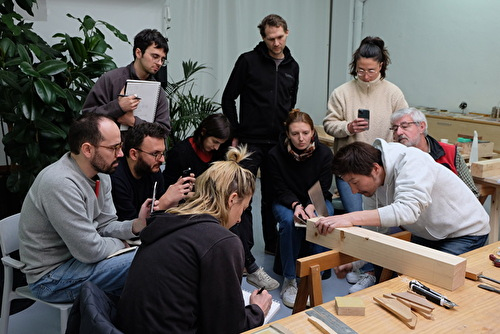
There is a limit to how many people one carpenter can teach directly.
There is also a limit to how many students a small school can accept.
But a book can travel much farther.
It may sit on a workshop shelf for twenty years.
It may be passed from teacher to student.
It may move from one workshop to another.
Years later, someone may happen to open it.
And perhaps that person will then pick up a tool.
Look at a piece of wood.
See it a little differently than before.
And begin to make something.
We hope this book can become that kind of beginning.
For woodworkers.
Carpenters.
Furniture makers.
Architects.
Designers.
Students.
Teachers.
And people around the world who are interested in Japanese craft and making.
FROM KYOTO TO YOUR WORKSHOP
HOW TO MAKE.
HOW TO SEE.
We hope this book will help you encounter both.
[EXPLORE THE FILMS / VIDEO LESSONS]
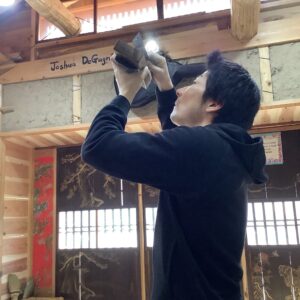
Takami Kawai / Suikoushya
Kyoto, Japan
In addition, it can also be purchased on the following sites.
🌍all over the world
🇯🇵
https://www.amazon.co.jp/Traditional-Japanese-Woodworking-Mastering-Timeless/dp/0764372408
https://www.kinokuniya.co.jp/f/dsg-02-9780764372407
🇨🇦
https://www.amazon.ca/Traditional-Japanese-Woodworking-Mastering-Timeless/dp/0764372408
🇬🇧
https://www.waterstones.com/book/traditional-japanese-woodworking/takami-kawai/9780764372407
🇺🇸
https://www.amazon.com/Traditional-Japanese-Woodworking-Mastering-Timeless/dp/0764372408
https://schifferbooks.com/products/traditional-japanese-woodworking
https://www.barnesandnoble.com/w/traditional-japanese-woodworking-takami-kawai/1149642133
🇦🇺
https://www.amazon.com.au/Traditional-Japanese-Woodworking-Mastering-Timeless/dp/0764372408
🇳🇿
https://www.fishpond.co.nz/Books/Traditional-Japanese-Woodworking-Takami-Kawai/9780764372407
🇿🇦
https://www.amazon.co.za/Traditional-Japanese-Woodworking-Mastering-Timeless/dp/0764372408
🇨🇳
🇳🇴
https://www.adlibris.com/sv/bok/traditional-japanese-woodworking-9780764372407